Builds the four per-model databases behind every verification SQL report in this series from DOI 1.12 onward — one row per 8×8-pixel image block, with SSIM and the eight comp_* features computed independently for the ground-truth, no-augmentation, and test-time-augmentation versions of every reconstruction.
| Location | Originally included in the DOI 1.12 Zenodo archive (Merutan_DOI1.12.zip), unmodified since; released again on its own, unedited, together with heatmap_tool.py and a screen-recorded demo, as DOI 1.19.1 |
|---|---|
| First established | DOI 1.12 (as the fix for the join-based data-integrity bugs described on the Technology page) |
| Used by | DOI 1.12 through 1.16 — the four databases it produces are reused unchanged, never rerun or edited, by every later report in the series |
| Status | Current — no superseded version exists |
New to this codebase? See the beginner-friendly, section-by-section code walkthrough →
For every image that has a ground-truth version, a no-augmentation reconstruction, and a test-time-augmentation reconstruction, this script:
This script is the concrete implementation of the design change described on the Technology page: computing SSIM and comp_* directly from the same set of loaded images in a single pass, rather than joining separately-generated tables together afterward. That earlier join step was a repeated source of silent data-integrity bugs at the scale of hundreds of millions of rows — see that page for the full story.
One DuckDB database file per run — pointed at one ground-truth folder and two reconstruction folders (no-augmentation and test-time-augmentation) — containing two tables. If you're comparing multiple models, run it once per model, each against its own pair of reconstruction folders; that's how we produced the four databases (Standard, SwinIR, High-Fidelity, Digital-Art) behind our own published reports.
Requires Python 3 with numpy, pandas,
duckdb, pillow,
opencv-python-headless, and scikit-image
installed, plus heatmap_tool.py in the same
directory — this script imports several functions from it
directly. heatmap_tool.py's own per-image
visualization feature is still being refined and will get its
own dedicated technical report once that work is finished; its
source code is published as-is alongside this script in
DOI 1.19.1 below.
python3 build_notta_tta_comp_db.py \
    --gt-dir /path/to/gt_images \
    --notta-dir /path/to/notta_recon \
    --tta-dir /path/to/tta_recon \
    --out std_notta_tta_comp.duckdb \
    [--workers N] [--chunk-size 20] [--limit N]
A single run compares one pair of reconstruction folders against
one ground-truth folder. If you're comparing several models
against the same ground truth, run it once per model, reusing
the same --gt-dir each time.
--workers controls how many images are
processed in parallel (default: all CPU cores minus two, so the
machine stays usable during a run); --limit caps how
many new images are processed, useful for a quick test before
committing to a full run.
Safe to interrupt at any point — a crash, a reboot, or a manual stop. On restart with the same command, any image already recorded in the output database's images table is skipped automatically, so an interrupted run simply picks up where it left off rather than starting over or risking duplicate rows.
View DOI 1.19.1 on Zenodo: https://doi.org/10.5281/zenodo.22838600
This script and heatmap_tool.py are also published
together as their own report, exactly as they stood on
2026-09-01 — the same code that produced every number in DOI
1.12 through 1.16. Anyone can point it at their own
ground-truth/no-augmentation/test-time-augmentation image
folders and build the same kind of database from their own data
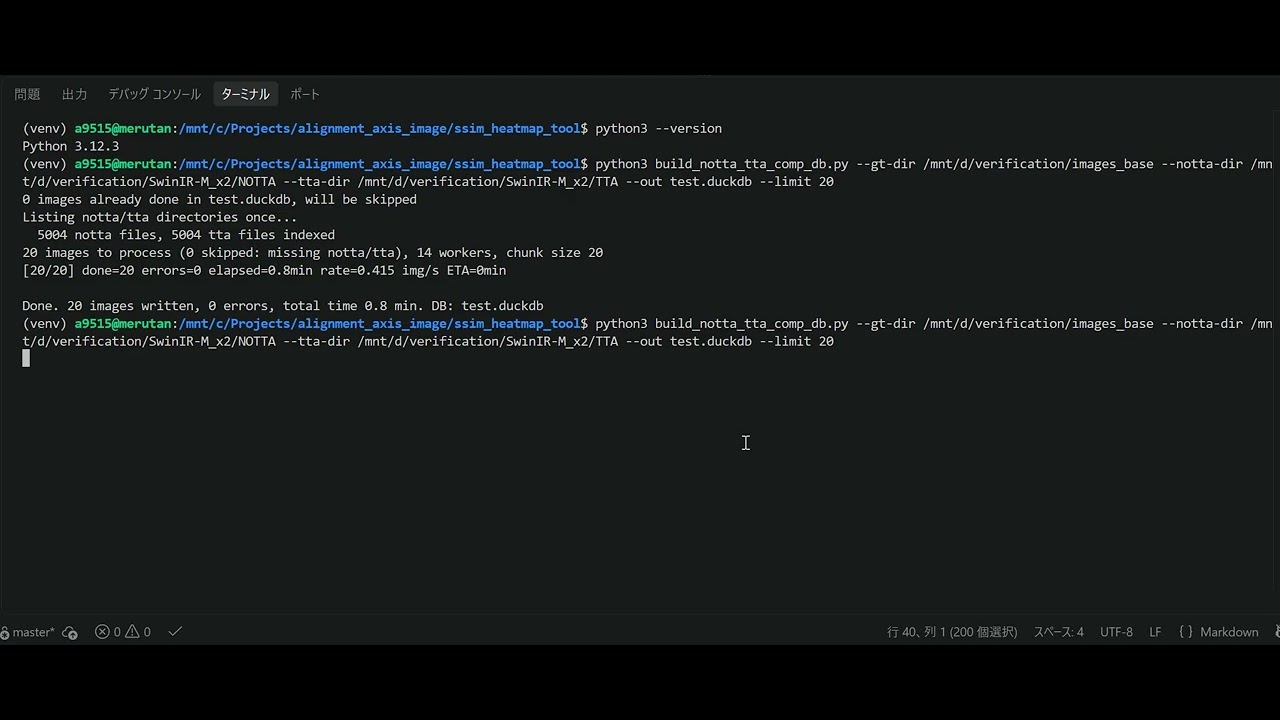
and models. The recording below shows an actual run
(--limit 20), executed twice in a row to
demonstrate resumability: the second run correctly detects the
20 images already processed and moves on to the next batch.
The DOI 1.19.1 release also documents two limitations carried
over unedited from this state: heatmap_tool.py's
generated HTML explanatory text is Japanese-only, and its
SIGMA_STAT dictionary is hardcoded to this
project's own dataset and four models
(SIGMA_C is the universal, closed-form value and
needs no such caveat). Anyone applying this to their own dataset
or model should re-derive their own SIGMA_STAT
value rather than reuse these as-is.
build_notta_tta_sigma_db.pyView DOI 1.21 on Zenodo: https://doi.org/10.5281/zenodo.23271571
build_notta_tta_sigma_db.py is a variant of this
script, written for DOI 1.21. It depends on the same
heatmap_tool.py and follows the same overall
approach (one independent, join-free database per model,
resumable in chunks), but extends the schema: alongside the
derived comp_* features this script stores, it
additionally stores σnotta/μnotta/σtta/μtta
as raw values. This was needed to measure DOI 1.21's
floating-point ghost
duplication correction directly, rather than through the
derived features alone.
Screen recording: two consecutive --limit 20 runs, unedited — the same resumability test as the DOI 1.19.1 recording above, run against this extended schema.
See the DOI 1.21 SQL walkthrough for how the resulting database is used.