
Approach
Our approach
Two cores run through everything we do.
- Full verifiability (open-science practice)
- Fast, verifiable publication via Zenodo (plus community review where a suitable one exists)
1. Open-science practice
Not hiding errors is what gives science its value
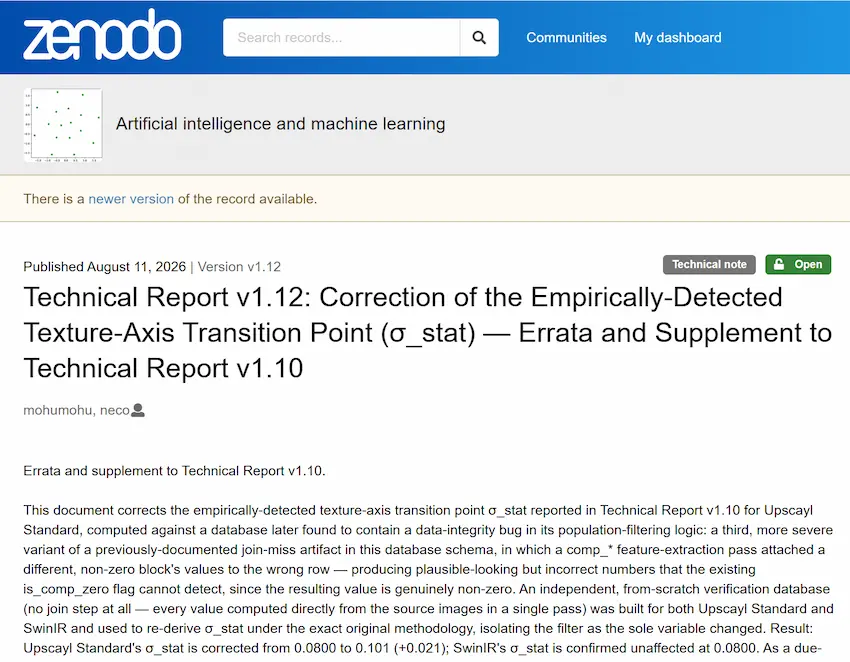
We do not hide our past errors. When a previously published technical report turns out to contain a mistake — a computation bug, a data-integrity issue — we don't just correct the number. We publish the entire process, including how the error arose and how it was found.
Genuine research is inherently gritty — it's built on trial and error, not a straight line to a sudden truth. We'd obviously rather not make mistakes in the first place, but showing that messy process without hiding it is exactly what lets a third party understand, and accept, why we arrived at a given conclusion.
This isn't a record of failure. It's an expression of our position that verifiability itself is what gives science its value.
One of our own corrections is a concrete example: finding and fixing a JOIN-based data-integrity bug is what led us to design an entirely new, JOIN-free data pipeline (see About).
Why open science matters now
Open science means publishing a study's process, data, and methods in a form anyone can verify and reuse. It isn't specific to any one kind of researcher — it concerns everyone involved in research.
Several structural problems in today's research environment are behind why this approach matters.
- The reproducibility crisis: peer-reviewed papers have repeatedly turned out not to replicate later.
- Peer review's limits: cases of fabricated or falsified data have gone undetected by peer review alone for years, and peer review itself is a human process carried out under time constraints — it isn't infallible.
- Over-trusting institutional prestige: fraud and misconduct scandals have happened even at prestigious universities, so "institutional affiliation = a guarantee of trust" isn't an accurate assumption.
- Environments that can't be reproduced: a result tied to undisclosed hardware, proprietary clusters, or compute resources most researchers simply don't have access to can't be independently checked by anyone outside the original team.
Verifiability is something every researcher needs, regardless of affiliation. That's exactly why we practice open science — publishing the entire process and data in a form anyone can check.
Open science isn't an option available to everyone, though. Trade secrets in corporate research, or confidentiality obligations at other institutions, can make it impossible to publish methods or data at all.
2. Choosing Zenodo
We publish our results on Zenodo, a free academic repository operated by CERN. Every record receives a permanent identifier (a DOI).
The advantages of Zenodo
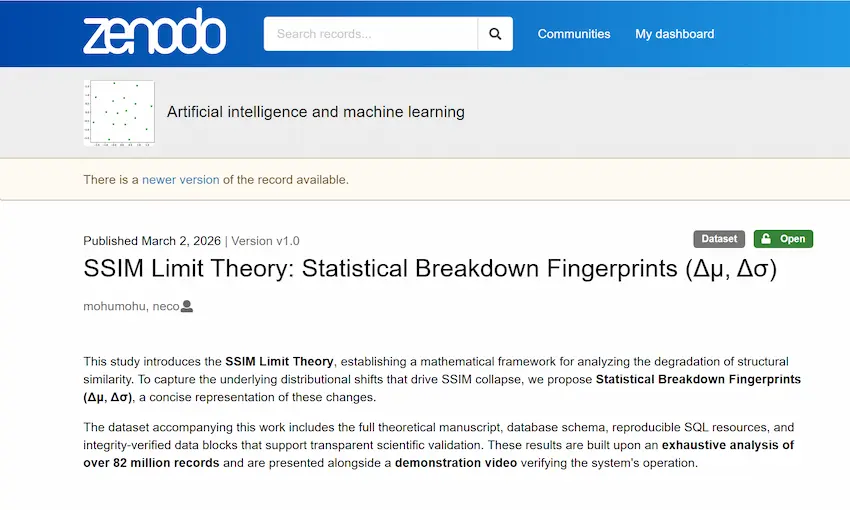
- Speed: you can publish a citable, dated record the same day, with no editorial queue. One of our own technical reports was downloaded several times within a single day of publication — a pace peer-reviewed publication simply cannot match.
- A solid proof of priority: you can show, with a date attached, that you were the first to reach a given result. When multiple people arrive at similar ideas independently, it becomes a third-party-verifiable record: proof you already had this result by a given date.
Limitations, and how we address them
This isn't without trade-offs. A Zenodo record hasn't been peer-reviewed, so it doesn't carry the same stamp of approval a peer-reviewed paper does — and any errors in it become public too. We've found and corrected mistakes in our own published work more than once (see Publications).
One way we can partly address that gap, when a well-matched curated community exists, is by seeking one out and submitting to it — not a required step, but one we took for this project because Zenodo's AI/ML community was a good fit (see About). Unlike Zenodo itself, which anyone can publish to without review, being accepted into a community whose curator actually reviews submissions means the work has passed an independent, third-party check — short of peer review, but not nothing either.
3. A licensing policy as a deliberate IP strategy
Every technical report we publish uses a CC BY-NC license. This isn't a formality — it's a deliberate IP strategy.
The risk of a permissive license like MIT
Publish under a permissive license such as MIT, for example, and this can happen:
- A company uses the work freely, at no cost.
- The company patents whatever applications it develops on top of it.
- The original author ends up unable to freely use their own extensions or applications of their own work.
Why CC BY-NC
CC BY-NC prevents this by withholding permission for commercial use by default. Any company wanting to use our research commercially has to seek permission first, which closes off the possibility of one-sided exploitation without compensation.
The goal is free use, not exclusivity
The point of this isn't only to protect ourselves. It's to protect a state where other researchers can use, cite, and build on our work with confidence.
Research use, citation, and adaptation: free for anyone.
Commercial use: requires prior permission.
The only thing we restrict is commercial use — free circulation and open use within the research community is exactly what we want to actively preserve and promote.